Site Menu:
| This is an archived Horseadvice.com Discussion. The parent article and menus are available on the navigation menu below: |
| HorseAdvice.com » Horse Care » Hoof Care, Hoof Trimming, Shoeing Horses » Trimming and Preparing the Feet for Shoes » |
| Discussion on Relieving or scooping the quarters | |
| Author | Message |
| Member: frances |
Posted on Thursday, Oct 22, 2009 - 8:11 am: Hi. Can anyone explain to me what relieving or scooping the quarters means? How and why is it done, and what does it look like?Many thanks. |
| Moderator: DrO |
Posted on Friday, Oct 23, 2009 - 7:20 am: Hello LL,Not having heard the term I am uncertain what it means and it may mean different things to different people so you should ask for an explanation from those who use it. It does sound a bit like the procedure recommended in the four point trim where pressure on the solar surface of the walls in the quarters is relieved. The procedure and reason for this is explained at Horse Care » Hoof Care, Hoof Trimming, Shoeing Horses » The 4 Point or Natural Trim. DrO |
| Member: ajudson1 |
Posted on Friday, Oct 23, 2009 - 10:46 am: https://www.chronicleforums.com/Forum/showthread.php?t=216717Here's a link discussing "scooping the quarters" I personally don't do it any more; instead I bevel the wall more at the quarters if there is a tendency to flare. If the hoof is trimmed level with or above the sole all the way around, the quarters may naturally end up "scooped" or lowered, but I don't believe in forcing it to get a certain "look." Always read the hoof, and consider the type of ground the horse is working/living on also. As I understand it, on soft ground, the hoof will be flatter and less scooping at the quarters, on rocky ground, the hoof will develop more concavity and the quarters may naturally break off more, or appear scooped due to the sole becoming more concave. If you have hoof or 4,  with questions about the trim, can you post pictures please? Side view of the whole horse, hoofs looking from the heel to toe underneath for starters. with questions about the trim, can you post pictures please? Side view of the whole horse, hoofs looking from the heel to toe underneath for starters. I believe the article DrO points to explains it, but I haven't read it lately. |
| Member: juliem |
Posted on Friday, Oct 23, 2009 - 3:59 pm: I've used the term to mean rasping the wall at the quasrters slightly (very slightly) lower than the toe and heel to "relieve" the pressure there which is where flaring usually starts. It prevents the flaring and the subsequent breaking away at the quarters. Don't know about "scooping" that sounds more like sole removal which I don't do. |
| Member: sodmonst |
Posted on Friday, Oct 23, 2009 - 11:35 pm: The quarters on this hoof appear to be very slightly shorter than the toe and heels.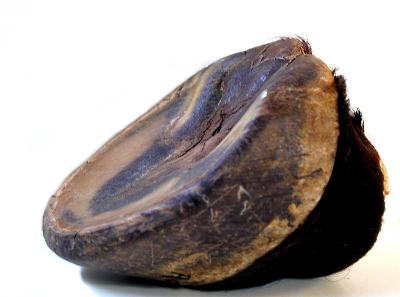
|
| Member: juliem |
Posted on Saturday, Oct 24, 2009 - 12:22 am: Good picture Suzie, that exactly what I was talking about! |
| Member: frances |
Posted on Saturday, Oct 24, 2009 - 8:34 am: Many thanks for the helpful replies.I noticed that the farrier had trimmed away what looked like a kind of vertical crescent or arc shape from my horse's RH foot at the lateral quarters, where she is inclined to grow a flare. The flare had gone. As she is shod, it was hard to see the detail, just the outline, but I suppose in reality it could have been like the hoof in Suzie's fantastically clear picture. I've heard the expression relieving the quarters and scooping the quarters, and I wondered if this was it? Someone on the internet commented that it was called "relieving" when it was considered to be a good thing, and "scooping" if not! I would post a picture, except that the farrier was back yesterday and now it's hardly visible any more. Anyway, food for thought and thank you again. |
| Member: ajudson1 |
Posted on Saturday, Oct 24, 2009 - 8:45 am: In simple terms I think scooping just means taking it off. I was told by my email helper to "scoop back the heels" and it didn't mean cut into the sole at all. If I think about this, I use the knife in a manner in which it is like "scooping out", say a melon? Maybe that is where the term came from, the action itself? And can apply to the quarters, heels, etc?The cadaver hoof above was made that way by the way the horse lived; I am not 100% convinced that we need to try to "scoop, carve, dig out or rasp off" to get that look. With only a couple years experience doing my 4 horses, I am not an expert by any means, I am leaning now towards creating an environment that helps create a good hoof. If following the sole for a guideline in trimming the outer wall still leaves flaring at the quarters, put a sharper angle on the bevel there. BTW, I searched through many of my barefoot hoof links for this scooping, and didn't find much on it. A few brief sentences, no pictures. LL, are we answering your questions? |
| Member: ajudson1 |
Posted on Saturday, Oct 24, 2009 - 8:59 am: I see we were typing at the same time.It's just different people putting different spins on what the word means. Best to see a picture with a detailed description. I wasn't aware that a farrier "relieved" the quarters when a hoof is shod. What sense does that make when the shoe stops expansion? Sorry, I am anti iron shoes.. |
| Member: scooter |
Posted on Saturday, Oct 24, 2009 - 9:27 am: I thought it strange to relieve the quarters with shoes too, I would think that could lead to trapping dirt and loosening the shoes.IMHO one of the only reasons I would relieve the quarters would be because of excessive flaring, tho I believe like Angie said (and am finding out on Hank) a good bevel works just as well or better. I never did like the thoughts of relieving the quarters in my absurd mind it seems like it would put additional pressure at the toe and heel. 
|
| Member: sunny66 |
Posted on Saturday, Oct 24, 2009 - 10:41 am: Brave gets his quarters "relieved" and he is shod. It does stop the flaring... my two cents which is all it's worth ;) |
| Member: rtrotter |
Posted on Saturday, Oct 24, 2009 - 11:05 am: Hello all,IMO the slightly concave appearance of the relieved quarter (as shown in the picture) is a naturally occurring phenomenon in a horse that self trims due to the environment and basically is not touched by human hands in order to accomplish that foot form. We, on the other hand, are constantly trying to get to that foot form in environments that are not suitable for it, so we do our best with the proper trimming, leveling and balancing that gets us to a point that we and our horses can live with. In the well balanced barefoot horse, this relief of the quarters happens as part of a natural trim, it is not a forced thing. It is as if this is what the hoof wants to do without any extra effort and what it does is allow for the foot to expand naturally on full contact with the ground. I know I shouldn't make comparisons between humans and horses but I look at this as the arch in a human foot, like a protective mechanism ( None of us want flat feet all the time, do we?). Now as far as a shod horse is concerned, I too couldn't figure out why the quarters needed to be relieved either. However, I started to think about where most of the problems happen in shod standardbreds and you guessed it in the quarters(quarter cracks) and from what, to much pressure right at that point. So this leads me to the conclusion that if those quarters can be relieved even if its just a little bit, any horse that wears shoes would be much better off with the quarters relieved than not. Just my thoughts Rachelle |
| Member: vickiann |
Posted on Saturday, Oct 24, 2009 - 12:05 pm: Well said, Rachelle. |
| Member: erika |
Posted on Saturday, Oct 24, 2009 - 8:43 pm: Angie, I always think of you as our resident "hoof guru". Would you kindly consider posting pix of one of your horse's hooves for us amateurs to see? I've been working on Sugar and would be inspired by yours, knowing you do them yourself.Like many members here, I get frustrated about professionals who don't know as much as owners here. |
| Member: maggienm |
Posted on Sunday, Oct 25, 2009 - 12:01 pm: It is my understadning that a horses hooves try ot expand whether restricted by shoes or not.The sides of the hoof expand more than the toe. It is because of this that there is actually more umm, force or pressure, not sure which is the correct term, put on the quarters. (Physics at work here) Thus the reason for relieving the quarters. For a hoof that is bound by a shoe the internal force is still there, so is the need to releive those quarters just a tad. I read that it was actually farriers who understood this that initiated the practice. (Who knows) In observing horses which have not had regular trimming their quarters do break out which would seem to back up this theory. A flare is the very beginning of a break out. As the hoof grows the flare continues to expand until just like a fingernail that bends back and breaks the hoof breaks off. (hope it doesn't hurt that much) |
| Member: frances |
Posted on Monday, Oct 26, 2009 - 5:59 am: Thanks a lot guys. That's very interesting, and I wholeheartedly agree with Erika's last paragraph
|
Horseadvice.com
is The Horseman's Advisor
Helping Thousands of Equestrians, Farriers, and Veterinarians Every Day
All rights reserved, © 1997 -
is The Horseman's Advisor
Helping Thousands of Equestrians, Farriers, and Veterinarians Every Day
All rights reserved, © 1997 -
