Site Menu:
| This is an archived Horseadvice.com Discussion. The parent article and menus are available on the navigation menu below: |
| HorseAdvice.com » Diseases of Horses » Skin Diseases, Wounds, and Swellings » Discussions on Skin Diseases not covered by above » |
| Discussion on Fungal infection (Mycetoma?) on hind leg | |
| Author | Message |
| New Member: hilary |
Posted on Tuesday, Oct 14, 2008 - 12:08 pm: We have a much loved 11 year old gelding of 15 hands in Cyprus, with a serious fungal problem.Some 3 years ago, a lump started to appear on the rear hock. It developed into a large subcutaneous soft area that was opened by the local vet to find a lot of black granular material. This was later identified as a fungus growing inside the leg and was referred to as a ‘Mycetoma’. A year later, after a period on 25 tablets a day of ‘Vafluson 200mg’, he was taken to the only equine surgical facility on the island and operated on (very expensively) to remove the fungus. At the end of the operation, the vet poured formaldehyde into the open wound. After returning to our stable, the wound was cleaned regularly with iodine and covered with a gauze skirt to protect it from insects and dirt until it healed. He was also on antibiotics for a period after the operation. A year ago, the area began to swell again and it was obvious that the fungus had returned. He was put on 20 tablets a day of ‘Griseofulvin 500mg’ and for a time it seemed that the lump had stopped growing. 6 Months ago, it was growing again and soft lumps were appearing around the area, that contained yellow pus with the black granular material in it. The infected area was spreading to the point of the hock and medication was increased to 40 tablets a day. After 3 months on double dose and no improvement, we DrOpped back to 20 tablets a day. We are continuing to clean the area with iodine regularly, but the lump is still getting worse. The local vet appears not to have any further answers, except another operation again, with no more hope of success than the first operation. The horse is fit and healthy in every other respect, has no pain or lameness and still enjoys regular exercise. Our question is – has anyone else experienced such a fungus and is there any other treatment out there? 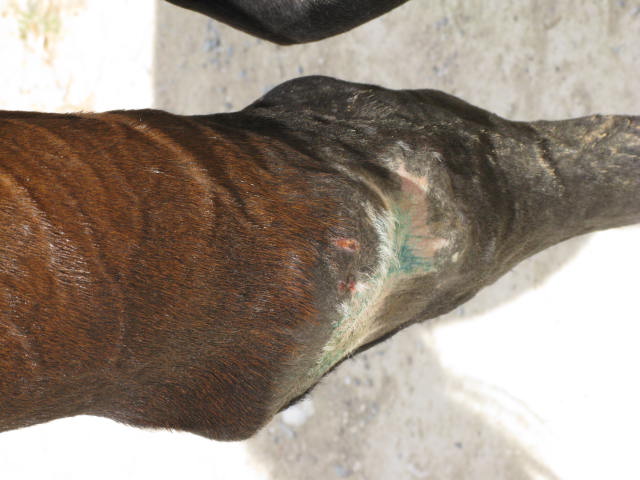 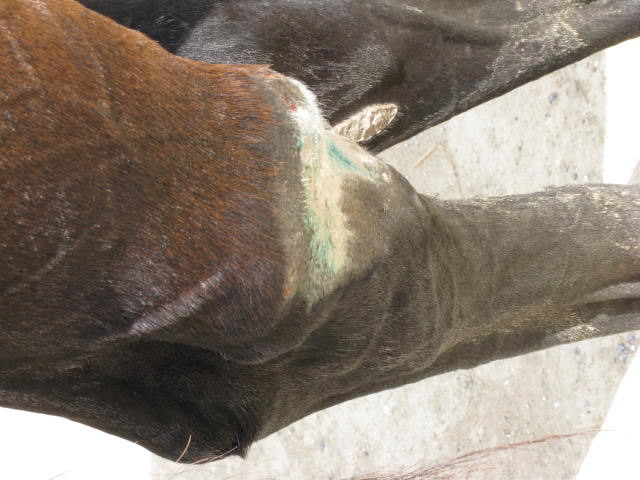
|
| Moderator: DrO |
Posted on Wednesday, Oct 15, 2008 - 8:17 am: Welcome John,The thing I see that needs to be done differently is you have to have surgery to debulk the mass then following surgery the horse needs to be put on a prolonged course of antifungal. Such masses have areas that are not well profused with blood so systemic antifungals alone will not treat it. Best is to find out what type fungus is growing and select a antifungal effective against it and recently in humans voriconazole has been used effectively against some of these "black grained" mycetomas. If there is recurrence early surgery and prolonged retreatment is your best chance. It should be noted that even with aggressive treatment the chance for a cure is guarded so take this in mind when making a decision on a prolonged expensive therapeutic regimen. DrO |
| New Member: morpur |
Posted on Wednesday, Oct 15, 2008 - 2:49 pm: I live in south florida and have a nine year old mare just diagnosed with pythiosis. Tissue was removed from the back of her front pastern near the coronet band. The area was then cauterized. Diagnosis was confirmed by Univ. of FL. She is showing no signs of lameness. It seems as there has become a somewhat common disease in our area lately. We had aprox. 20" of rain from a tropical storm about a month ago. Is there any other treatment that holds promise other than just waiting for it to return. I had a different horse that earlier in the summer had an eye infection that turned fungal and responded well to Fluconazole would this have any benefit? Is there any connection to my recent invasion of fungus? |
| Moderator: DrO |
Posted on Thursday, Oct 16, 2008 - 7:40 am: No gayle I don't think there is a connection other than they were all fungal infections. The best treatment will depend on the actual organism.DrO |
| New Member: morpur |
Posted on Thursday, Oct 16, 2008 - 10:03 am: I have discovered there is a immunotherapy treatment available with 3 subq injections. The info I have read on this looks promising. I don't see a downside except the cost of the drug which is not prohibitive. Do you have any experience with this Drug. It is manufactured by Pan American Veterinary Labs in Texas. |
| Moderator: DrO |
Posted on Friday, Oct 17, 2008 - 8:21 am: Promising for what gayle? While such nonspecific therapy might be helpful as an adjunct to treating infections, it would not do as primary therapy and such products tend to have a higher than average adverse reactions. After all a common adverse reactions to injections is overstimulation opf the immune system.DrO |
| New Member: morpur |
Posted on Friday, Oct 17, 2008 - 10:02 am: The only other primary therapy that has been proposed is cut a removal of the tissue. This has been done but the fungus returns in a large percentage of patients. Basically the location of the fungus allows only so much to be removed without compromising the soundness of the leg. This therapy is very specific for this fungus. It was approved in 2005 and I am trying to find info on people that have had any success in treating this disease. |
Horseadvice.com
is The Horseman's Advisor
Helping Thousands of Equestrians, Farriers, and Veterinarians Every Day
All rights reserved, © 1997 -
is The Horseman's Advisor
Helping Thousands of Equestrians, Farriers, and Veterinarians Every Day
All rights reserved, © 1997 -
