- This topic has 25 replies, 2 voices, and was last updated 1 month ago by
 Robert Oglesby DVM.
- AuthorPosts
- August 8, 2025 at 8:55 pm #22431
lsweeney
MemberMy otherwise normal 8-year-old Friesian mare appears to be experiencing a mild colic or something else we don’t know.
My husband fed hay this morning. He says she came down to eat, but we don’t know how long she ate. I went to feed her concentrates about 1 hour later and couldn’t find her. She was behind our house, and apparently not interested in coming down. Very unusual. She passed a large manure pile that was watery with almost formed balls (pretty normal for her). No interest in me or any food that I might have.
Put a halter on her and she lay down. Not thrashing around. Quiet. Temp 98.1 and 98.4. Pulse 32. Took her to the lawn where it is cool. She lay down there too.
My other mare is showing no signs of any issues, and they do EVERYTHING together.
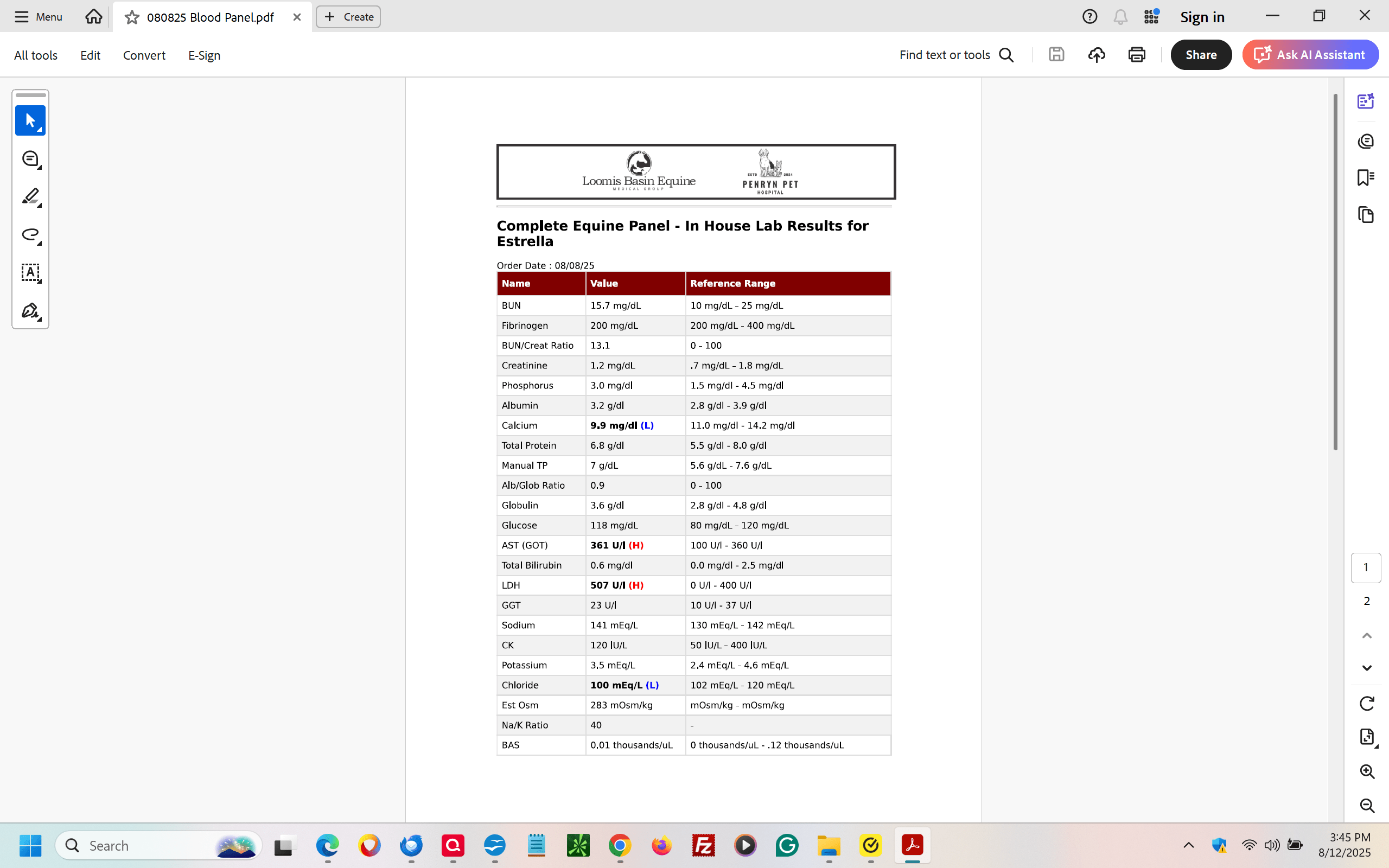
Took her to the vet. Lethargic. Instead of her maniac self, she stood quietly while being poked with needles. Barely noticed the other horses. Bloodwork attached. Nothing remarkable on Xray. They oiled and pumped electroytes into her. I elected not to do the belly tap or ultrasound given that so far everything was pretty much normal. I thought I would give it a few hours. (I live close to the vet.)
At home she is quiet, but still lethargic. Mild interest in my lawn. She is not laying down or rolling. 2 hours later she had mild interest in the other horse getting fed. I let her out to see if she would try to eat. She did. I put her back in her pen with no feed. Just water. I offered her a small piece of carrot which she did spit out. It looks like she is interested in bland feed. (Similar to the horse that I had years ago that was in kidney failure.) She finally did perk up and wanted me to scratch her belly.
Bloodwork attached.
She has gone nowhere in the last 2 weeks. Things that could have upset her stomach: Acorns are starting to fall, but not very many. She is an addict. She ate a ton of these last year, with no problems, but my other mare did have issues. We don’t have the same acorn load so far this year. Small, green apples from my one apple tree from the day before. 2 small pieces of a Honey Due melon rind. 1 small horse cookie that was stale. All these things were from the day before. They have access to a pond that I have been monitoring for blue green algae. There is some algae in the pond, but it doesn’t look like the usual toxic algae slime. I have a test kit.
I did change hay from Orchard to Teff, Orchard/Meadow Mix and Meadow. (First I tested it for palatability, and now I’m mixing it.) They have been eating this for about a week. No alfalfa for years. My husband fed the Teff this morning. However, I frequently mix different flavors of grass hay with no ill effects.
I’m curious about the low temperature. Any other ideas? Thoughts on anything else I should do at this point. I’m monitoring to see if I have to take her back for an ultrasound and belly tap. I opted for the x-ray to rule out metal, stones, sand and any other foreign object. They are on 3 acres, not penned up.
Thank you!
Laurie
Attachments:
- August 10, 2025 at 7:16 am #22434
 Robert Oglesby DVMKeymaster
Hello Laurie,
We did not get the labs, which I would like to see. This was not an uncommon presentation and with the lack of significant findings on physical and labs usually a temporary problem that passes without serious effects. Presumed is a mild colic of unknown origin or a mild afebrile virus. Later I added some of the infectious bowel diseases, just a mild form. I noticed the horse ate after the flunixin as she continued to eat? The transient low body temperature is something I would often see in horses on a cool morning after a quiet night. The important thing is to monitor for any worsening of clinical signs suggesting a more serious disease.
DrO - August 10, 2025 at 4:20 pm #22435Member
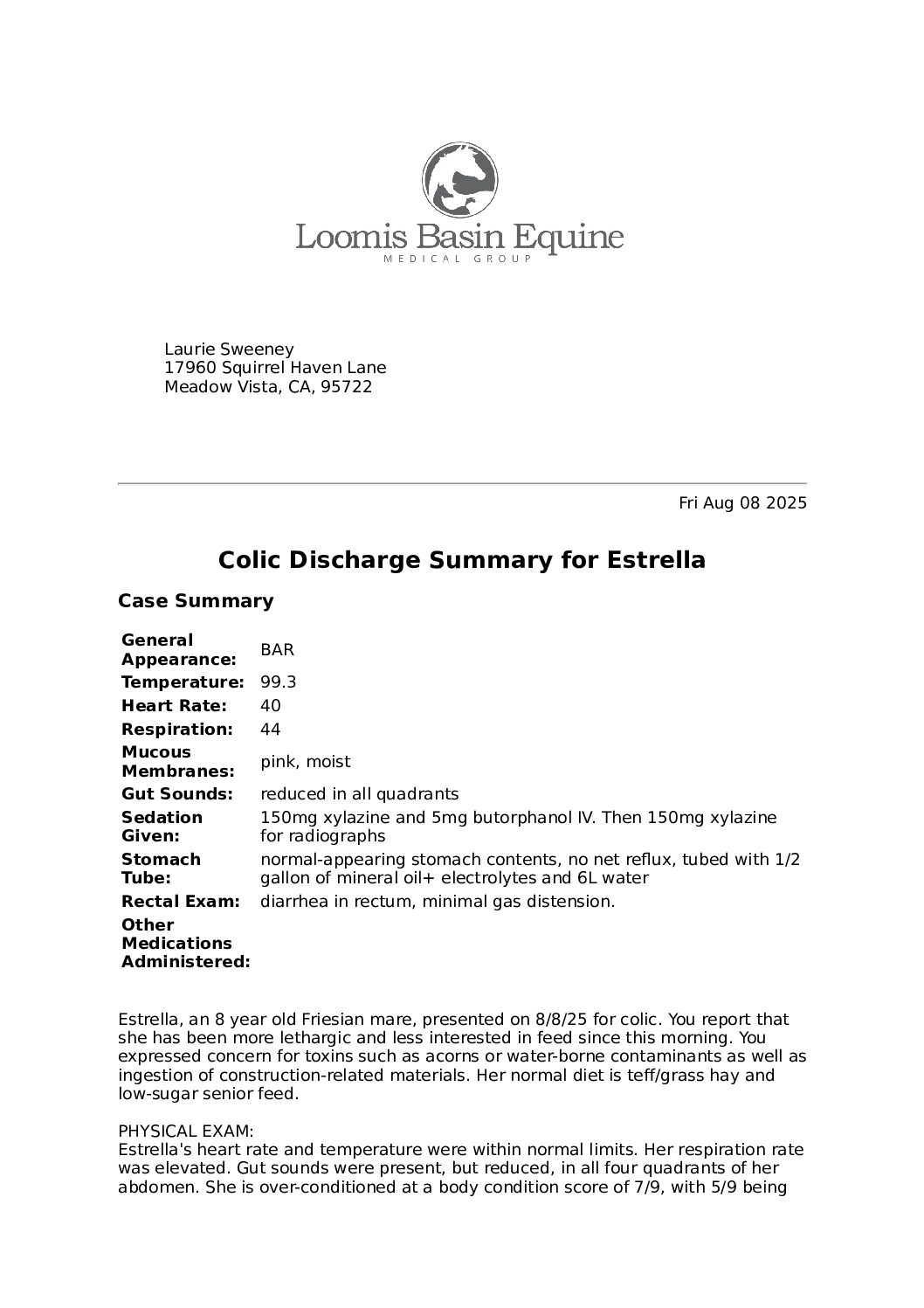
Colic Discharge Summary for Estrella
Case Summary
General
Appearance: BAR
Temperature: 99.3
Heart Rate: 40
Respiration: 44
Mucous
Membranes: pink, moist
Gut Sounds: reduced in all quadrants
Sedation
Given:
150mg xylazine and 5mg butorphanol IV. Then 150mg xylazine
for radiographs
Stomach
Tube:
normal-appearing stomach contents, no net reflux, tubed with 1/2
gallon of mineral oil+ electrolytes and 6L water
Rectal Exam: diarrhea in rectum, minimal gas distension.
Other
Medications
Administered:
Estrella, an 8 year old Friesian mare, presented on 8/8/25 for colic. You report that
she has been more lethargic and less interested in feed since this morning. You
expressed concern for toxins such as acorns or water-borne contaminants as well as
ingestion of construction-related materials. Her normal diet is teff/grass hay and
low-sugar senior feed.
PHYSICAL EXAM:
Estrella’s heart rate and temperature were within normal limits. Her respiration rate
was elevated. Gut sounds were present, but reduced, in all four quadrants of her
abdomen. She is over-conditioned at a body condition score of 7/9, with 5/9 being ideal. No other abnormalities were found.
RECTAL EXAM:
There was diarrhea present in Estrella’s rectum.
ABDOMINAL RADIOGRAPHS:
We took x-rays of Estrella’s belly to look for sand, enteroliths (stones), or metal
foreign material. The radiographs have been sent to the radiologist for secondary
review. The results will be communicated to you when they become available.
BLOODWORK:
Mild hypocalcemia, mildly elevated muscle enzymes.
We discussed additional diagnostics today including abdominal ultrasound and
abdominocentesis (belly tap). We also discussed monitoring in the clinic. These
were declined in favor of monitoring closely at home at this time.
Most colics respond well to medical therapy including pain medications, stomach
tubing, and feed restriction with gradual re-feeding. However, if colic signs are
persisting, additional tests such as bloodwork, abdominal x-rays, abdominal
ultrasound, and abdominal fluid testing may be indicated to help determine the
cause of the discomfort and guide appropriate therapy.
Medications
Banamine Paste: Give 1250# orally once tonight. Then give 1000# orally once
tomorrow morning.
Feeding Instructions
No feed for tonight (water is fine). Then, if Estrella is staying comfortable and
passing manure, you may start refeeding with small frequent meals of soupy
pelleted feed. Over the next 36-48 hours, gradually increase the amounts and time
between feedings until back to the normal diet.
Housing
Keeping Estrella in a smaller area for the next 2-3 days is recommended to allow
you to monitor comfort, feed and water intake, and manure production. - August 11, 2025 at 6:25 pm #22437Member
Ultrasound results: Ultrasound results: Diagnosc Interpretaon. There are small mineral (sand) accumulations in the cranioventral abdomen, most likely involving the large ventral colon (possibly the sternal flexure) (Figure 1, arrowheads). The accumulations are approximately measured at 20–25 cm in length and up to 3 cm in height. They are continuous caudally with less-defined and slightly less-opaque material, extending caudally along the ventral wall, still likely in the ventral colon (Figure 1, arrows). That material is poorly delineated from the remainder of the colon content, which has more homogeneous opacity than normally expected. The ventral colon haustraons remain visible, though slightly flaened. Gas-filled intestinal loops are seen at the presumed mid-dorsal abdomen, possibly including distended small intestinal loops Conclusion: Moderate colon sablosis, of possible clinical relevance (ddx : sand colic/impacon).Possible small intestinal ileus
- August 11, 2025 at 6:51 pm #22438Member
I’m not seeing the other files coming through. I emailed them to you.
- August 12, 2025 at 3:50 pm #22439Robert Oglesby DVMKeymaster
The first lab work
Attachments:
- August 12, 2025 at 3:55 pm #22441Robert Oglesby DVMKeymaster
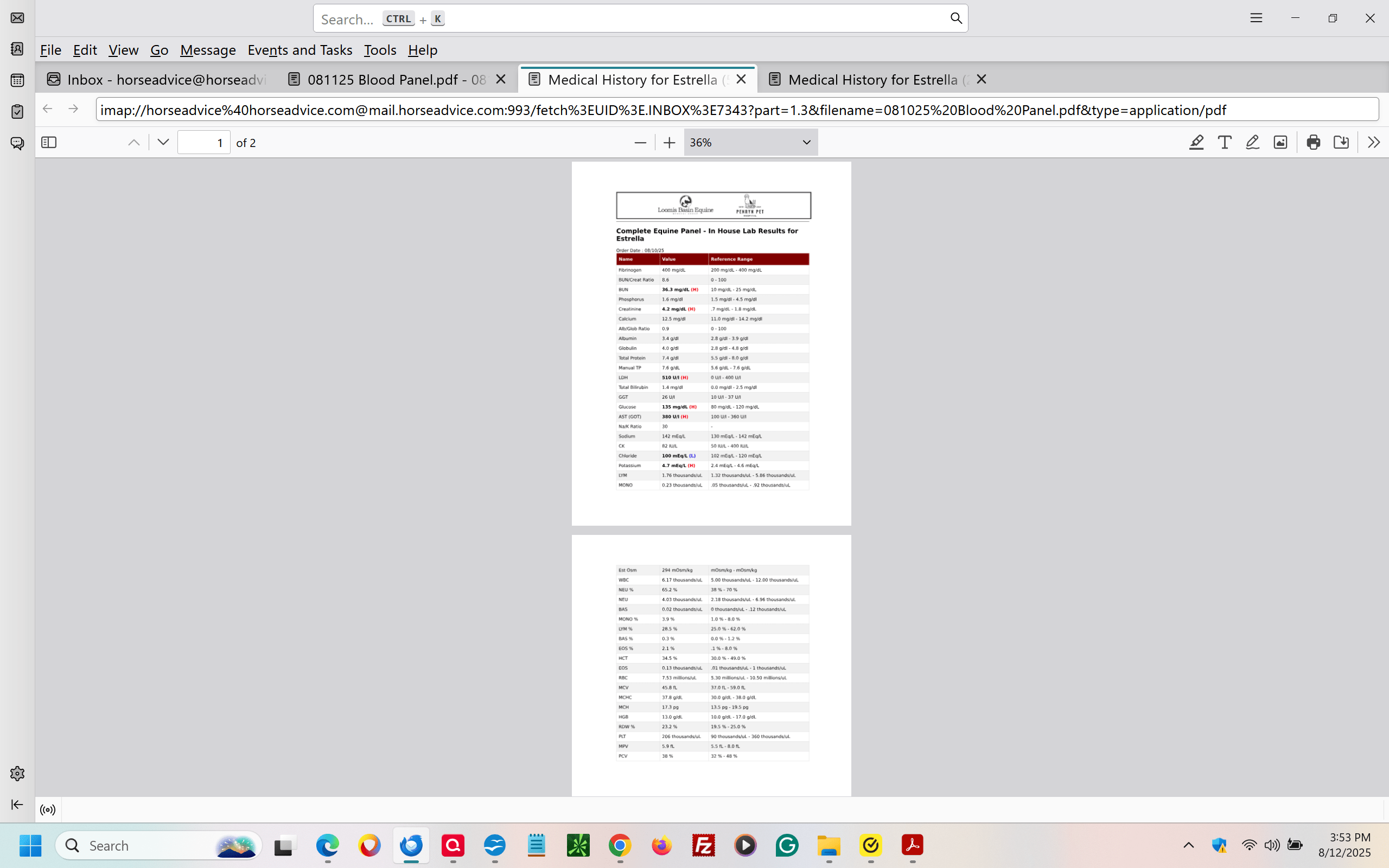
The second lab work:
Attachments:
- August 12, 2025 at 4:01 pm #22445Robert Oglesby DVMKeymaster
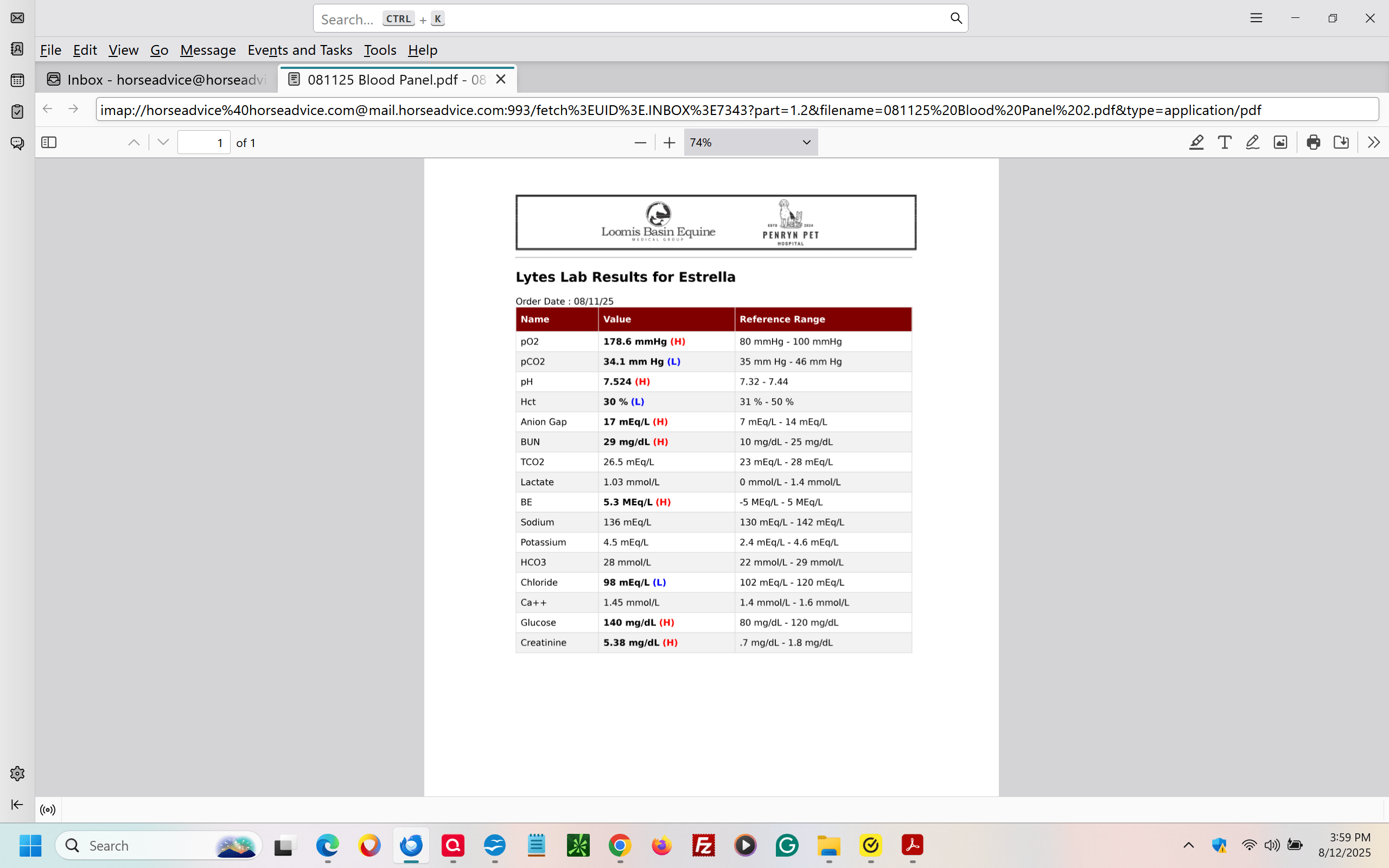
The third lab work:
Attachments:
- August 12, 2025 at 4:07 pm #22447Robert Oglesby DVMKeymaster
Laurie what do the veterinarians say about the azotemia: the rise in BUN and Creatinine? It suggests kidney failure as the CBD and proteins suggest that hydration is adequate.
DrO - August 12, 2025 at 6:17 pm #22449Member
They flushed charcoal through her system. Some kind of toxin. I know she has eaten plenty of acorns over the years. I don’t know if some trees can be more potent than others. I kept running them off of my neighbor’s tree last week. I just had a vet walk my property looking at potential poisonous plants other than acorns. My other mare has eaten everything that Estrella has. She’s fine. I’m having bloodwork done on her today to make sure. – But she has no signs of colic or illness.
I am walking my property looking for acorns. I have 3 acres. I picked up about 15 acorns. Last year, I could stand in one spot and fill a bucket. My neighbor’s tree had quite a few. I wondered if there could be some other contamination with rotting acorns – fungus, etc.
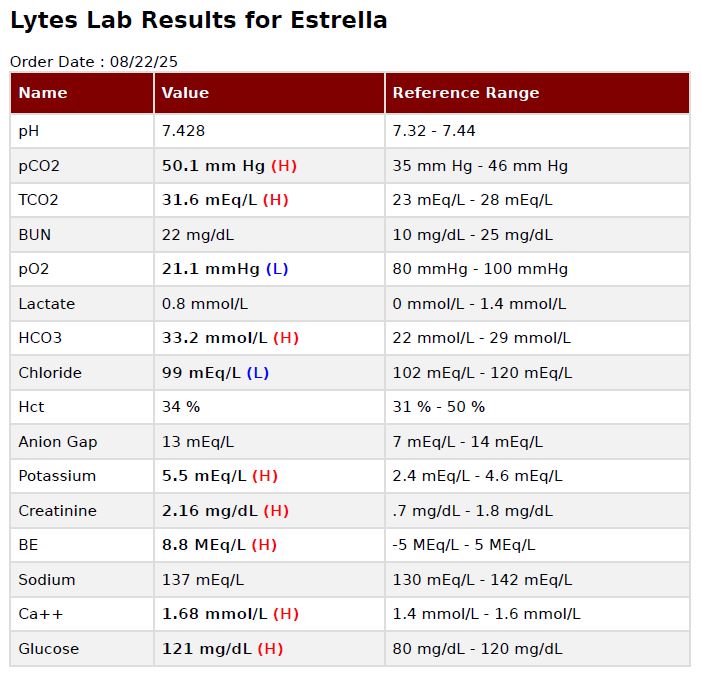
Creatinine dropped slightly last night and more this morning: Lytes Lab Results for Estrella Order Date : 08/12/25Name Value Reference RangepH 7.499 (H) 7.32 – 7.44 BUN 25 mg/dL 10 mg/dL – 25 mg/dLpCO2 36.6 mm Hg 35 mm Hg – 46 mm HgTCO2 26.9 mEq/L 23 mEq/L – 28 mEq/LLactate 1.19 mmol/L 0 mmol/L – 1.4 mmol/LpO2 47.5 mmHg (L) 80 mmHg – 100 mmHgAnion Gap 17 mEq/L (H) 7 mEq/L – 14 mEq/LHct 31 % 31 % – 50 %Chloride 98 mEq/L (L) 102 mEq/L – 120 mEq/LHCO3 28.4 mmol/L 22 mmol/L – 29 mmol/LBE 5.2 MEq/L (H) -5 MEq/L – 5 MEq/LGlucose 143 mg/dL (H) 80 mg/dL – 120 mg/dL Creatinine 4.59 mg/dL (H) .7 mg/dL – 1.8 mg/dLCa++ 1.39 mmol/L (L) 1.4 mmol/L – 1.6 mmol/LSodium 137 mEq/L 130 mEq/L – 142 mEq/LPotassium 3.9 mEq/L 2.4 mEq/L – 4.6 mEq/L
-
This reply was modified 6 months ago by
lsweeney.
-
This reply was modified 6 months ago by
- August 14, 2025 at 8:05 am #22451Robert Oglesby DVMKeymaster
Here is information on Oak and Acorn Toxicity. The charcoal and fluids are logical therapy. How is urine production and characteristics?
DrO - August 20, 2025 at 3:13 pm #22456Member
Sorry for the lapse in communication. She is home. She is scheduled for another blood test on Friday. Here is her last blood result after pulling her off of IV fluids for 20 hours: Lytes Lab Results for EstrellaOrder Date : 08/18/25Name Value Reference RangepH 7.459 (H) 7.32 – 7.44pCO2 46.7 mm Hg (H) 35 mm Hg – 46 mm HgpO2 37 mmHg (L) 80 mmHg – 100 mmHg BUN 22 mg/dL 10 mg/dL – 25 mg/dLLactate 1.42 mmol/L (H) 0 mmol/L – 1.4 mmol/LAnion Gap 13 mEq/L 7 mEq/L – 14 mEq/LTCO2 31.5 mEq/L (H) 23 mEq/L – 28 mEq/LChloride 97 mEq/L (L) 102 mEq/L – 120 mEq/LPotassium 4.1 mEq/L 2.4 mEq/L – 4.6 mEq/LBE 9.3 MEq/L (H) -5 MEq/L – 5 MEq/LHct 29 % (L) 31 % – 50 %HCO3 33.1 mmol/L (H) 22 mmol/L – 29 mmol/LSodium 136 mEq/L 130 mEq/L – 142 mEq/L Creatinine 2.57 mg/dL (H) .7 mg/dL – 1.8 mg/dLGlucose 119 mg/dL 80 mg/dL – 120 mg/dLCa++ 1.58 mmol/L 1.4 mmol/L – 1.6 mmol/L
- August 20, 2025 at 3:16 pm #22457Member
The one issue that I’m having with her is that she will only drink out of a small green bucket. She won’t drink out of the big 70 qt buckets. She will pick the green one over the small orange, red buckets. Bizarre. Her normal trough is in the pasture with oak trees. It has fresh water running through it to our pond. She will drink from this one. I’m building a pen that will allow her access to that trough.
She is eating well. Otherwise, appears normal.
- August 20, 2025 at 3:24 pm #22458Member
Her kidney’s were normal-sized in the ultrasound. My sense is that we did everything wrong on the onset. No charcoal and treated with banamine.
- August 22, 2025 at 7:00 am #22461Robert Oglesby DVMKeymaster
I don’t see it that way, all you can do is operate with the information you have at that time. The initial lab work did not show kidney problems, and a mild colic is certainly on the list of problems. There was not a strong argument for oak (or any other kind) toxicity. Often the only way to rule out a mild colic is a dose of flunixin. As long as hydration is good this is not that toxic and if it helps a horse feel better, so they eat and drink, that is a good thing.
DrO - August 23, 2025 at 4:34 pm #22462Member
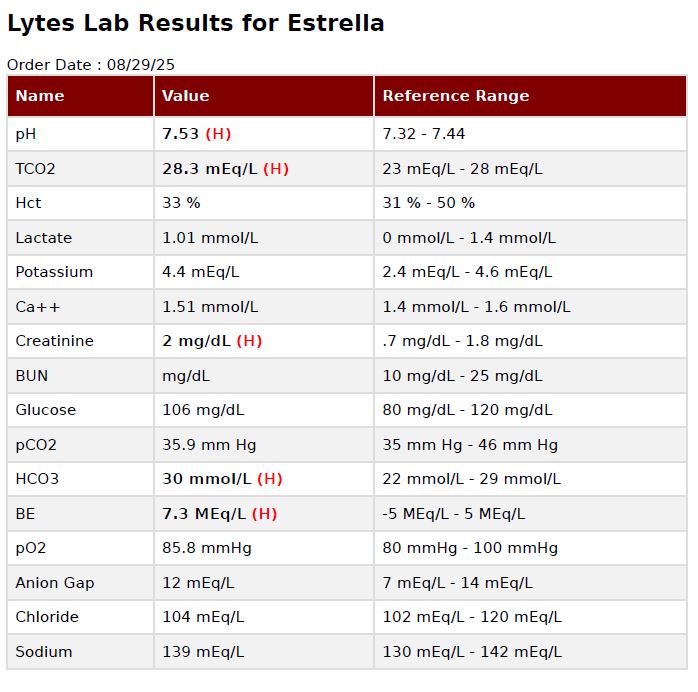
Here is her bloodwork Friday Morning. Last IV Fluids were Sunday at noon. Down from 2.57. She had Triple Crown Senior 1 lb at 6:30am, and probably another 1/2 lb in the trailer on the way over to the vet. Blood drawn 8:45AM. She has had a LOT of grass hay, as I have been keeping it in front her. Not sure how much of either has contributed to the high potassium or if it is kidney-related. The vet was happy with the drop in creatinine. Another blood test is scheduled for next Friday.
Attachments:
- August 29, 2025 at 5:24 pm #22470Robert Oglesby DVMKeymaster
I missed your post last week. The very low oxygen suggests the whole blood sample sat a while before the tests were run. Potassium will leak out of the RBC’s in stored whole blood increasing the serum concentration. So, this is possible. But kidney dysfunction can also affect K levels. This seems unlikely with the mild and improving azotemia. Yes, the decreased azotemia is encouraging. Still doing better this week?
DrO - August 31, 2025 at 8:12 pm #22472Member
The vet explained that the blood test they are running is not designed for a venous draw. I’m guessing that it is for a horse on IV fluids or ?? Anyway, she told me that I could ignore some of the parameters because of this. She has been home since 8/18, so any bloodwork after that have been pulled normally, but using the same test protocol. However, she is relying on the creatinine and potassium values. Here is her last blood test from Friday, 8/29/25. I was hoping for a normal creatinine value, but we aren’t there yet. I am soaking her hay, and it appears to have been effective for the potassium range. She appears to be normal from the outside: Eating, drinking and pooping. No exercise yet. The vet wants another week of no exercise which ChatGPT agrees with, but Grok wants 2 weeks of no exercise. LOL I have been pitting the two AI engines against each other, and it is pretty funny how snarky and argumentative they get when I reference a competing computerized analysis. It’s hotter than hell, so we won’t being doing much of anything regardless. She is currently walking to my neighbor’s lawn and back. I installed a mister, and she is getting hosed off.
Attachments:
- September 2, 2025 at 8:33 am #22474Robert Oglesby DVMKeymaster
Creatinine still headed in the right direction! (BUN?) How does she feel?
DrO - October 15, 2025 at 10:10 pm #22553Member
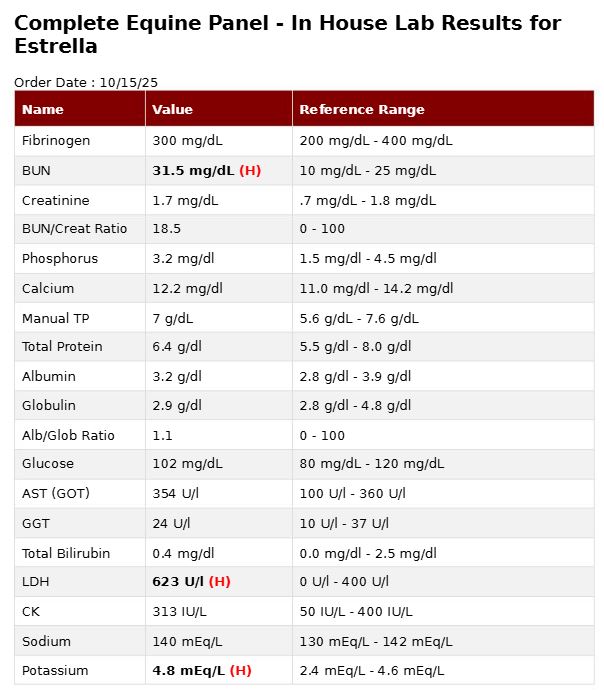
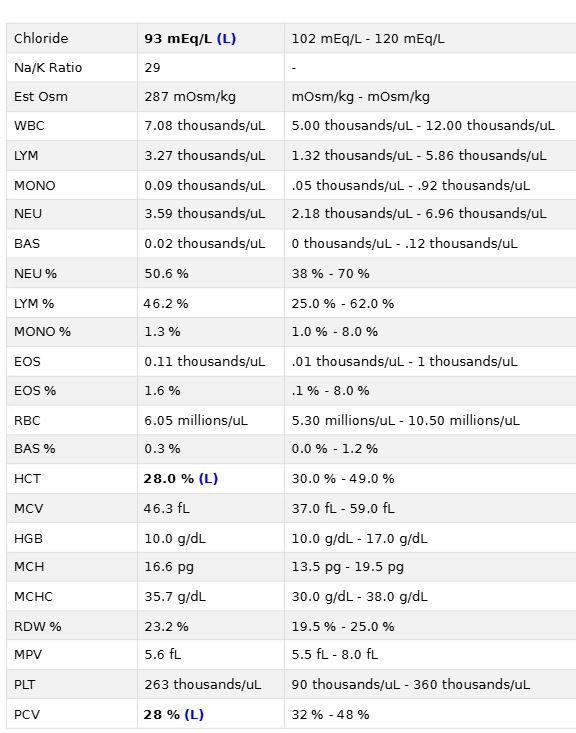
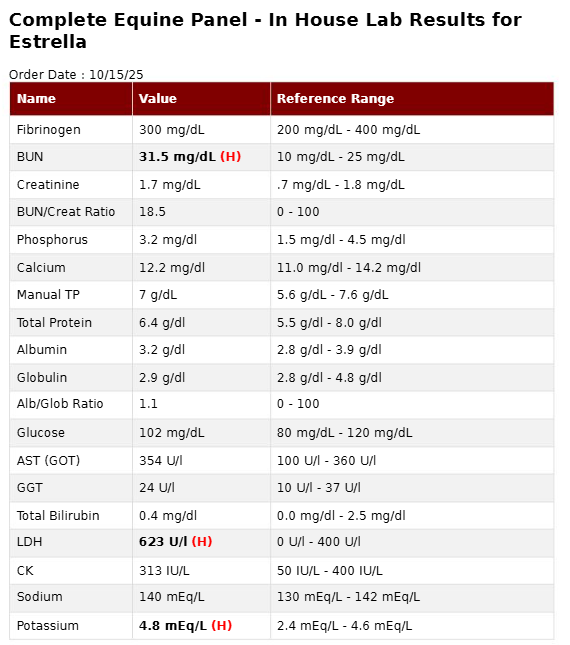
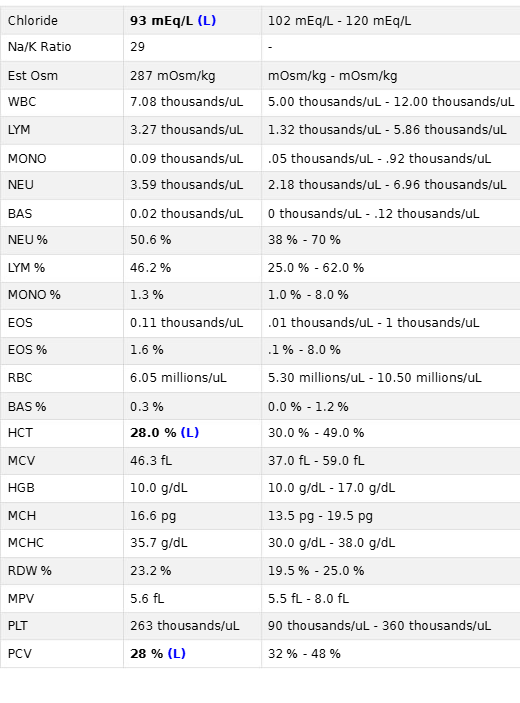
Full blood panel today. Vet feels Estrella is overweight. Weighed in at 1389 and should target 1300. She is 16.1. Last night she had a large flake of 80/20 Grass/alfalfa, unsoaked. (It was raining, and I failed. LOL) She has been getting Teff soaked 14.8 NSC, Orchard/Meadow (soaked) and small amounts of 80/20 Grass alfalfa. She is also getting 2-3 lbs. of LMF Senior Noncarb and Triple Crown Low Starch combined. She is probably getting around 22 lbs of feed including the concentrates. She is also getting Platinum Performance GI for vitamins. She has not been getting a lot of exercise (awaiting blood results), but she did go to the arena over the last couple of days and was lunged for about 20 minutes. Interestingly, I found this article on normal Friesian blood values which actually puts some of her under/overs to normal for Friesians. https://www.fenwayfoundation.com/friesian-blood-values I’m hoping that the high BUN (which has been fairly normal – we didn’t get a value the last time) is from the alfalfa.
- October 19, 2025 at 2:02 pm #22564Member
Given the rest of the blood panel, is it reasonable to assume that the BUN is diet-related, or should I push further?
- October 21, 2025 at 3:46 pm #22569Robert Oglesby DVMKeymaster
Hi Laurie,
Considering the other normal values, it is hard to be too worried about renal failure, and other causes of pre and post renal azotemia with the exception of the high protein diet. But this lack of worry is counter-balanced against the history of acorn exposure and elevated creatinine levels earlier this year. Hmmm. You need a urine specific gravity to rule out renal disease as horses lose their ability to concentrate urine before the ability to remove BUN and creatinine from the blood. Collection is sometime problematic but otherwise this is simple and inexpensive and conclusive for middle to later stage renal failure. If water consumption is normal and the urine looks concentrated kidney disease is unlikely. With the weight problem it sounds like the alfalfa should be removed from the diet. For more on this see https://horseadvice.com/horse-equine/diseases/urinary-system/kidney-disease-and-failure-in-the-horse/.
DrO - January 15, 2026 at 1:38 pm #22625Member
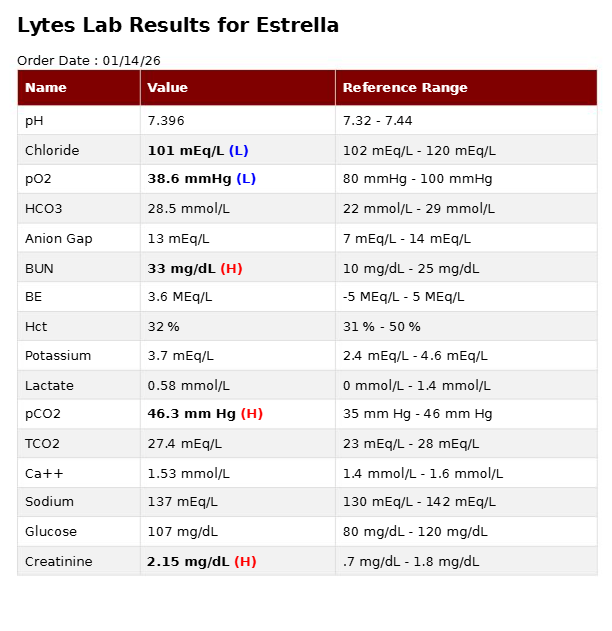
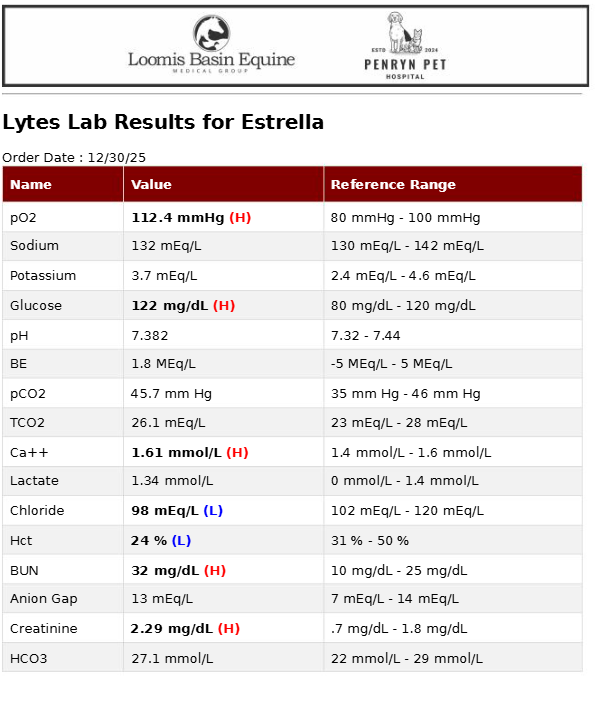
Well, things were looking up in October. Not so much now. She was released for normal exercise in October. The horse is completely normal in all aspects. I took her in for a dental, and we decided to check her kidney values. To our surprise they were back up to 2.29 creatinine (12/30/25). I was clueless as to why. We tested them again yesterday (1/14/26). The creatinine has come back down to 2.15, but still not in normal range. The vet said that the only thing that I had told her that she felt relevant was that 1) I had stopped soaking hay during the last 2 weeks of hay prior to the December test, because it was raining and primarily because I had changed hay (I thought I was soaking hay because of high NSC in the old Teff and potassium in the Orchard – not to hydrate her). 2) I had ridden at high elevations. We live at 2,000′, but we have a cabin at Tahoe. We rode for a week at Tahoe in late October. We typically trailer up, and then ride the following day. So a little bit of time to acclimate. The longest ride was probably 6 miles. The 6-mile ride, where she was very wound up, was at 8,000′. We trailered there, so she didn’t have to do the climb, but there was definitely some 500′ up and down. While she was threatening to break my hackamore and testing my riding ability, I didn’t see any signs of fatigue. She ate and drank normally. However, upon researching, this may indeed be in play. It was around 10/31/25 that this occurred. All the other rides in November and December were at a lower elevation. She was very wound up for an 8-mile ride with some hills on a November ride. We only walk and trot, but this horse is quite hot, so not unusual for her to be jigging on the way home. While my understanding is that these values are probably survivable, the elevation news has a big impact on our activities. I’m also 69 years old, and weighing how I am going to keep this horse healthy and active as my age advances. Do you think she could carry a foal? Looking for ways that she could be of value to someone. By the way, she is a champion, 1st premium, provisional crown, champion-of-the-keuring, mare. She had enough value that people would have considered doing an embryo transfer with her. I just want her to be healthy and happy. It is unfortunate that I was completely ignorant to the impact that high altitude riding might have on her. 🙁 Side note: We worried about the HTC, but apparently it is normal for it to be lower: https://www.fenwayfoundation.com/friesian-blood-values
-
This reply was modified 1 month ago by
-
This reply was modified 1 month ago by
- January 19, 2026 at 6:54 am #22634Robert Oglesby DVMKeymaster
Hello Laurie,
If I understand you correctly you are worried about renal disease / failure from the possible earlier insult that resulted in a more severe azotemia last fall. And, though she still has a mild azotemia, she has a normal attitude and exercise tolerance. To pursue this concern I would do a morning urinary exam following a night of no water available, see https://horseadvice.com/horse-equine/diseases/urinary-system/normal-urination-and-urinalysis-in-horses/. Perhaps from there your questions will be more accurately answered. While doing this I would also exercise (lunge with trot and canter sessions) her for 15 minutes and retake the hematocrit to see if it returns to more normal values.
DrO- January 20, 2026 at 1:10 pm #22641Member
My main question is really around what your experience is with elevation riding in the face of compromised kidneys and what you believe the useability of this horse is. Her hematocrit was normal in the January bloodtest that I attached. I was just noting that it is normal for their HCT to be lower than the average horse ranges. I have GROK and ChatGPT arguing over whether she can carry a foal. My only interest with breeding is that she might be able to produce a foal for someone – perhaps embryo transfer where she would have value. Otherwise, at my age, I am looking at setting up a trust for her so that she may live out her life with possibly a lease for “calm” riding at lower elevations – which is tough for her given how “hot” she is. GROK thinks I have a view good years left. Perhaps an equestrian caregiver who also takes care of old people. LOL
-
This reply was modified 1 month ago by
-
This reply was modified 1 month ago by
- January 21, 2026 at 10:52 am #22644Robert Oglesby DVMKeymaster
Lynn, it depends on the nature of the disease. In short, I allow horses with chronic disease of any kind to do what they are comfortable with and don’t remember ever regretting such a standard. Would I recommend a horse with a chronic kidney disease to be bred and foal out? No, not unless I believed the compromise was mild and non-progressive.
DrO
- AuthorPosts
- You must be logged in to reply to this topic.