- This topic has 0 replies, 1 voice, and was last updated 1 year ago by
 Robert Oglesby DVM.
-
AuthorPosts
-
-
July 24, 2025 at 10:07 am #22421
 Robert Oglesby DVMKeymaster
Below is the abstract and following are excerpts from the article and the quiz given to assess positioning accuracy. Together this should help teach proper positioning of the saddle.
DrOHow accurate are riders in assessing saddle position?
J Equine Vet Sci. 2025 Jul 21:105655. doi: 10.1016/j.jevs.2025.105655. Online ahead of print.
Authors
M Douglas 1 , J Williams 2 , H Randle 3
Affiliations1 School of Agriculture, Environmental and Veterinary Science, Charles Sturt University, Wagga Wagga, New South Wales, 2652, Australia. Electronic address: mdouglas@csu.edu.au.
2 Department of Equine, Hartpury University, Gloucester, GL19 3BE, UK.
3 School of Agriculture, Environmental and Veterinary Science, Charles Sturt University, Wagga Wagga, New South Wales, 2652, Australia.PMID: 40701224
DOI: 10.1016/j.jevs.2025.105655Abstract
Background: Recent research has highlighted the detrimental impact of an ill-fitting saddle on equine health, welfare and performance. A correctly fitting saddle may not fit if positioned incorrectly.
Aims: This study assessed riders’ ability to visually evaluate saddle position and examine factors that influenced accuracy of assessment.
Methods: Survey participants were provided with photographs of a series of saddles on horses obtained from the lateral aspect of the left side of the horse. Saddles were either correctly positioned (n=5), too far forward (n=5) or too far back (n=2). This was independently confirmed by three accredited saddle fitting professionals. The survey was distributed via snowball sampling on social media over an 3-week period in 2021.
Results: There were 401 participants, who, on average, correctly identified 58.25% of the saddle positions. Riders’ ability to correctly assess saddle position (mean 58.25% correct) was not related to rider age, experience and discipline (all Kruskal-Wallis tests P>0.05). However, participants who had previously had their own saddle fitted professionally were better able to correctly assess saddle position (60.8±19.0% correct) compared to those who had not (52.2±19.0%; KW (1) = 12.59, P < 0.001). Conclusion: Given a substantial proportion of riders in this study were unable to identify correct saddle position these results are concerning due to a likely increased risk of causing the horse discomfort and compromising welfare. Given the increasing focus on ethical and sustainable equitation practice, this lack of knowledge regarding a fundamental piece of horse-riding equipment must be addressed as a priority. Introduction
For correct saddle positioning, the front of the saddle tree points should be approximately 4-6 cm behind the caudal proximal aspect of the scapula, and the tree length should not extend beyond the 18th thoracic vertebra (T18) [20].
Experts agree that riders tend to position their saddles too far forward [[10], [11], [12],21,22], which is no subsequent movement of the saddle occurs, results in the tree points to be positioned too close to the caudal border or over the scapula, reducing range of movement and increasing localized pressure [11,20,21]. Conversely, saddles positioned too far back cause the front of the saddle to tip downwards, increasing pressure behind the scapula [11], and disrupting optimal alignment. A correctly fitting saddle that is incorrectly positioned is very likely to compromise the horses back health causing pain, reduced welfare, gait regularity and consistency [13], and impaired back and locomotory function and performance [10,20].
Despite the implications for equine welfare and performance, research specifically on saddle positioning and evaluation by horse owners/riders is limited to date. The aim of this study was to investigate riders’ ability to visually assess saddle position on a static horse and identify factors influencing their accuracy in saddle position assessment.Survey design and distribution
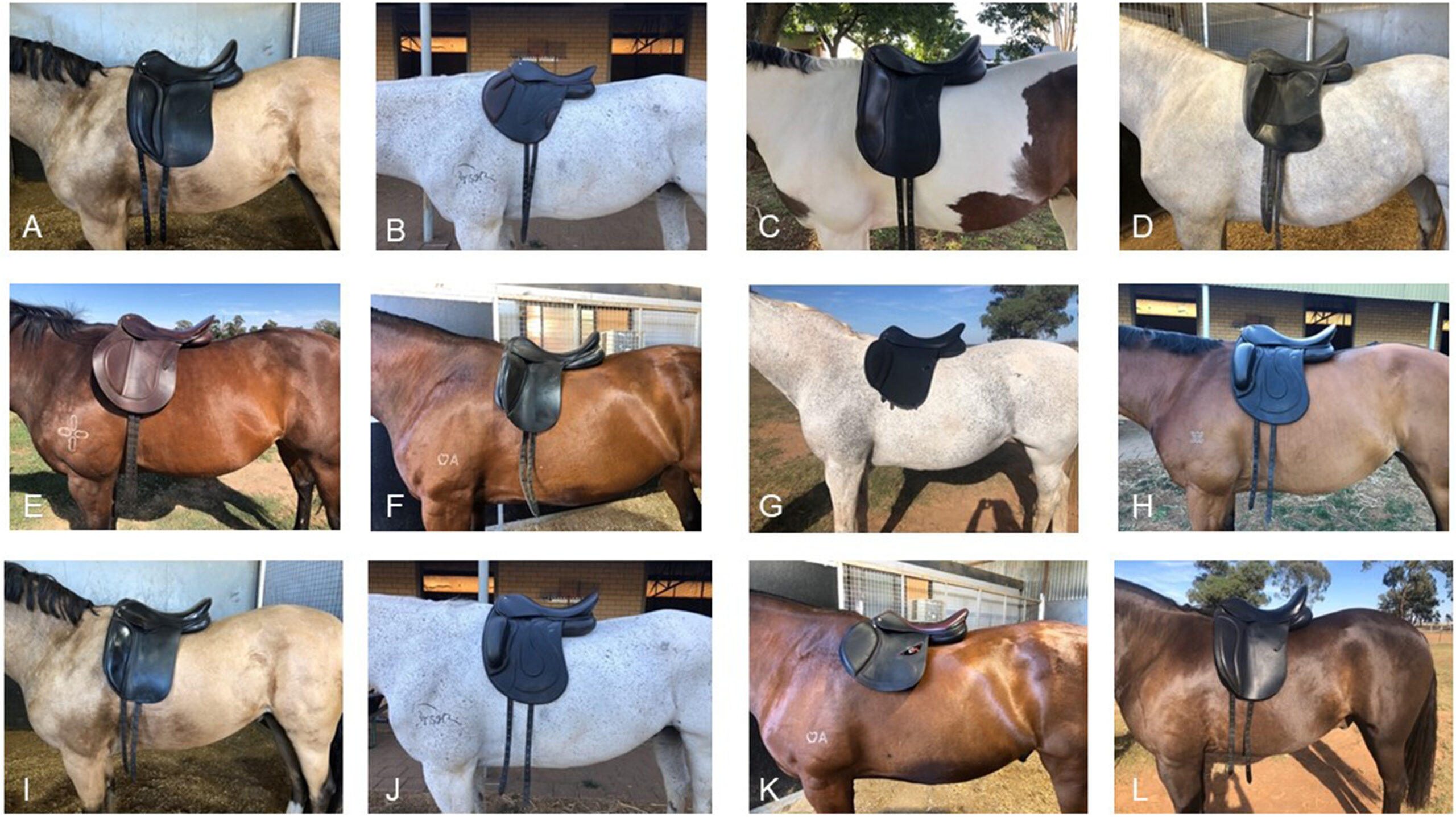
Check the image above for positioning then check it against the explanation below.
Fig. 1. Photographs of the 12 horse/saddle combinations included in the survey. Saddle position was confirmed by independent accredited saddle fitter (saddle position was not provided to participants in the survey). Five saddles were positioned correctly (A, F, G, J, K), five saddles were positioned too far forward (B, C, E, H, I) and two saddles were positioned too far back (D, L).
Keywords: Equine; equitation; fit; performance; welfare.
Copyright © 2025 The Author(s). Published by Elsevier Inc. All rights reserved. The excerpts are used with permission.
Keywords: Equine; equitation; fit; performance; welfare.
Copyright © 2025 The Author(s). Published by Elsevier Inc. All rights reserved.
-
-
AuthorPosts
- You must be logged in to reply to this topic.